 A year ago I could have found Calabria, the region at the very toe of the Italian “boot,” on a map, but would have been hard-pressed to tell you much about it. Today, although I have not yet been there and still have much to learn about the area, I feel I know more about it than many other Italian regions, and it has moved up to the top of my list of places in Italy I would like to visit. Why? Rosetta Costantino of Oakland.
 Alex, Cassie and I took our first cooking class with Rosetta in Emeryville this past February, and a good deal of what I learned about Rosetta’s background is described on the post I did following that class. A few weeks ago we learned that she would be giving another class on Calabrian cuisine on our side of the Bay - at our favorite cooking school at the Cavallo Point resort in Ft. Baker, just north of the Golden Gate Bridge.
 The class filled up almost immediately after it was announced, but the three of us managed to sign up.
 One of the reasons we particularly wanted to take another class from Rosetta at this time was that she has just come out with her long-awaited cookbook entitled “My Calabria,” and we were eager to see it and pick up copies. Rosetta has been working on the cookbook for five years in collaboration with Janet Fletcher (who also wrote the wonderful 2004 San Francisco Chronicle article about Rosetta and her family, which was where we first heard Rosetta’s name) and all reports indicated it was worth waiting for.

So, a bit before 4:00PM on Saturday we arrived at the Cavallo Point cooking school were we were met by Rosetta and her mother, Maria Dito, who had happily joined Rosetta for the class and who is featured in many places in My Calabria. Jayne Reichert, the director of the cooking school, was also there with her staff, Rosalyn, Jen and David.
While we were getting settled, the staff poured us some Col Vetoraz prosecco which we enjoyed with local cheese and the superb bread baked at Cavallo Point’s Murray Circle restaurant by the resort’s pastry chef, Ethan Howard, who earlier honed his skills at Bouchon, Martini House and The French Laundry.
 While Ethan’s bread has nothing to do with Calabria, it is a sufficient reason in itself to visit Cavallo Point. Just incredible crust, texture and flavor – in my view the equal of Tartine’s rustic country loaf which is among my local gold standards.
Jayne kicked off the program with an introduction of Rosetta and some reminders about knife safety, and we then reviewed our handout with recipes for the following dishes which we were to prepare that evening (the page numbers indicate the pages in My Calabria where the recipes for those dishes appear):
~ Fried eggplant balls (Polpette di Melanzane) as an appetizer [p. 32-33]
~ Hand-Made Calabresian fusilli pasta with tomato sauce [pp. 85-87 -- we dressed the fusilli with the tomato sauce prepared for the vrasciole rather than the sugo di capra (goat sauce) paired with the fusilli in the cookbook]
~ Stuffed pork rolls in tomato sauce (Vrasciole [Calabrian for “bracciole”] alla Verbicarese) [pp. 196-198]
~ Cauliflower salad with anchovies and olives (Insalata di Cavolfiore) [p. 240]
~ Flourless walnut cake (Torta di Noci) [pp. 341-342]
Rosetta then gathered us around and gave us a brief demonstration of the preparation of each dish. After that, we were divided up into groups to work on the individual dishes. I was assigned to eggplant balls/cauliflower salad, Alex pulled pork roll duty and Cassie went off to work on the walnut cake.
 All of the teams' preparations went very smoothly with liberal help from Rosetta and the Cavallo Point crew (and Maria!!). The most interesting dish we prepared during the evening was the Calabrian fusilli. In most parts of Italy fusilli refers to the corkscrew shaped pasta pictured below.
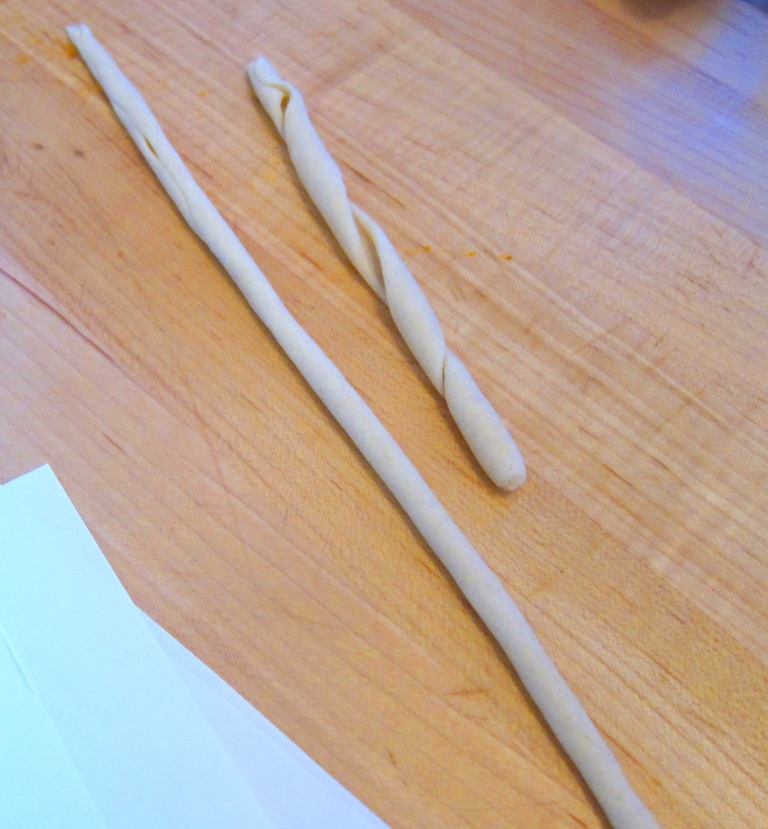
 However, in Calabria it is a completely different pasta. First of all, Calabrian pasta, like other Southern Italian pasta, uses no eggs – just flour and water (incidentally, Rosetta mentioned that she prefers to use organic unbleached flour made by Central Milling from red hard wheat, which is available at COSTCO). However, it is the means of preparation and shape that sets Calabrian fusilli apart. The pasta is first rolled out into a long thin rope about the thickness of a pencil which is then cut into smaller segments of about 4 inches each. Then you take a #1 knitting needle (or, as we did, a clean length of metal clothes hanger wire), press it down into the pasta, then roll the cylinder while spreading it along the length of the wire. When it is sufficiently thin, you then deftly (at least Maria and Rosetta did it deftly) slide it off the wire in a smooth motion leaving a long, hollow tube of pasta. The following photo shows some of the fusilli we prepared and here is a video I took of Rosetta demonstrating the preparation.
 Maria also showed us how to make another Calabrian pasta shape – called filei or, more descriptively, ricci di donna (“woman’s curls”) – in which the same pasta segment is wrapped around the wire in a spiral and then rolled in the same matter. See the following photo with examples of both fusilli and filei pastas.
 In the midst of our work, as an appetizer we fried and served the eggplant balls which were very easy to prepare and very tasty.
 All the dishes came together nicely at the end of the evening and we took our seats while the Cavallo Point staff dished up the courses. We started with a first course of the fusilli dressed with some of the tomato sauce in which the pork rolls had been cooking. That was served with a Greco di Tufo “Terrantica” white from the I Favati winery in Campania.
 That was followed with a serving of the Vrasciole alla Verbicarese with the Insalata di Cavolfiore, accompanied by an Aglianico “Contado” from the Di Majo Norante winery in Molise.
 The meal was topped off with a piece of the walnut torta accompanied by a dollop of whipped cream enhanced by a splash of Passaro Nocino (walnut liqueur) from Scalea in Calabria.
 If you want to try to make that liqueur yourself using fresh walnuts, the preparation is described here in Rosetta’s Calabria from Scratch blog (mark your calendar for next June 24).
All of the dishes were excellent and ones which I would make again. I thought the fusilli were especially notable – a very nice meaty consistency and weight to them. The pork rolls were exceptionally tender and tasty (they were filled with ground fat and parsley so they remained moist) and the dessert (which we had also made at the February class) was a perfect light end to the meal. The cake’s airy texture and flourless preparation seemed quite similar to the hazelnut torte we had enjoyed on our recent trip to Piemonte (see #12 at this post), and Rosetta confirmed that the same dish could be made using various nuts.
At the end of the dinner we were able to purchase copies of My Calabria which Rosetta kindly autographed (Maria signed mine too!). More about that below. However, perhaps the real treasure of the evening was a bag of spices – ground sweet and hot Calabrian peppers and wild fennel seed -- which Rosetta and Maria had brought along for me, and which will be finding their way into some of the fresh Calabrian sausage we learned to make at the February class. The wild fennel seeds had been painstakingly harvested by Maria by hand, a process described in the cookbook at page 215. It was yet another fun evening at Cavallo Point -- special thanks to Jayne and her hard-working staff.
 On the following day I curled up with My Calabria and made my way through most of it. It is a wonderful book – far more than just a cookbook and an introduction to Calabrian cuisine, it includes a good deal of information about Rosetta’s family and upbringing in Calabria, as well as information about places to visit in Calabria. In fact Rosetta just returned from leading a culinary tour of Calabria in October which is described in this post on her blog. The tour visited many of the places that are described in My Calabria. Rosetta spends a good deal of time on her Calabria from Scratch blog and it is a very effective supplement to her new cookbook.
My Calabria also benefits from the photography of Sara Remington (if I had one wish, it would be that more of Sara’s photographs could have been included in the book), and the collaboration of Janet Fletcher mentioned above. Alex, Cassie and I were fortunate to take several courses from Janet at the Cheese School of San Francisco and always found her to have a knack of putting food in the social and geographical context from which it comes. That same knack can be seen in Janet’s other books and in her regular “Cheese Course” column in the Chronicle, and it resonates throughout My Calabria.
However, what I have personally valued most about the time we have spent with Rosetta and reading her blog has been the way in which she conveys her family’s philosophy towards food, which includes preserving their, growing in their suburban back yard much of the food that they consume (see the following photo of Rosetta with her father, Vincenzo, with the tomato plants in their back yard which looks like something out of the Amazon rain forest), and wasting virtually nothing. This was impressed on me again on Saturday night in a small way when, in the midst of preparing the cauliflower salad, Maria came over and asked Jayne if she could take the discarded cauliflower greens home to feed to their rabbits. As Rosetta points out in the book, her parents’ experience in Calabria, especially during the difficult period at the very end of World War II, left them “with a deep aversion to waste and a profound respect for what nature provides.”
A few weeks ago Oliveto hosted a dinner featuring some of the dishes in My Calabria and they also shared a very nice video online showing a recent visit to Rosetta’s backyard garden.
If you have not completed your holiday gift shopping, I can assure you that anyone with any interest at all in Italian food would love My Calabria. Hopefully a visit there will be in the cards during 2011!


 Posts
Posts


