Saturday, April 24, 2010

Anglo-Italo Cooperation Results in St. George’s Day Success

In a post last month I mentioned how, on a recent visit to Wellington’s Wine Bar in Sausalito, we both learned of the impending celebration of St. George’s Day at Wellington's, and sampled Wells Bombardier for the first time. A most auspicious day on both counts.

Yesterday was St. George’s Day and I met up with a couple of friends, Kaz and Antonio, at Wellington’s to join the party. Wellington’s was about as full as I have ever seen it and there was a definite festive atmosphere beyond the customary TGIF buzz.

Wellington’s proprietor, Jeremy John, had arranged with Alfredo Ancona to provide the food for the event. Alfredo is the chef at Angelino in downtown Sausalito, and, with his wife, Tara, owns CIBO just across Bridgeway from Wellington’s. Jeremy and Alfredo had settled on a menu for the evening of:

~ Porchetta – the classic herb-seasoned Italian pork loin, which Alfredo prepared rolled in pork belly with the skin outside
~ Minted fresh English peas
~ Mashed potatoes

The meal would conclude with the classic, but curiously-named, English dessert – spotted dick.


I was also eagerly anticipating the event since it would mark the Wellington's premiere of the “caja China” (literally “Chinese box”) – a cooking box originally devised by Chinese immigrants to Cuba in the 1800’s, which is now being manufactured and distributed by a firm in Florida named La Caja China.

The box is made of heavy plywood lined on the inside with metal and has a removable cover with a metal tray. The food is placed on a rack inside the box, the box is covered, and hot coals are piled in the tray on top. The food is then cooked by radiant heat.

Alfredo had recently purchased a caja China and was going to fire it up to cook the porchetta. Here is an excellent video showing the preparation and cooking of a whole pig in a caja China.

When we arrived at Wellington’s, Alfredo and his CIBO colleague, Jorge, were already well along with the porchetta. We ordered some Bombadiers and joined them on the deck overlooking the Bay.


Not long after we arrived, Alfredo lifted off the caja China top and flipped the rack holding the porchetta.

The crowd began to grow a bit restive with the spreading fragrance of roasting meat, but happily the porchetta was soon done and emerged in all its glory.

Jorge then quickly heated the peas...

... and Alfredo began carving the porchetta for the salivating masses.
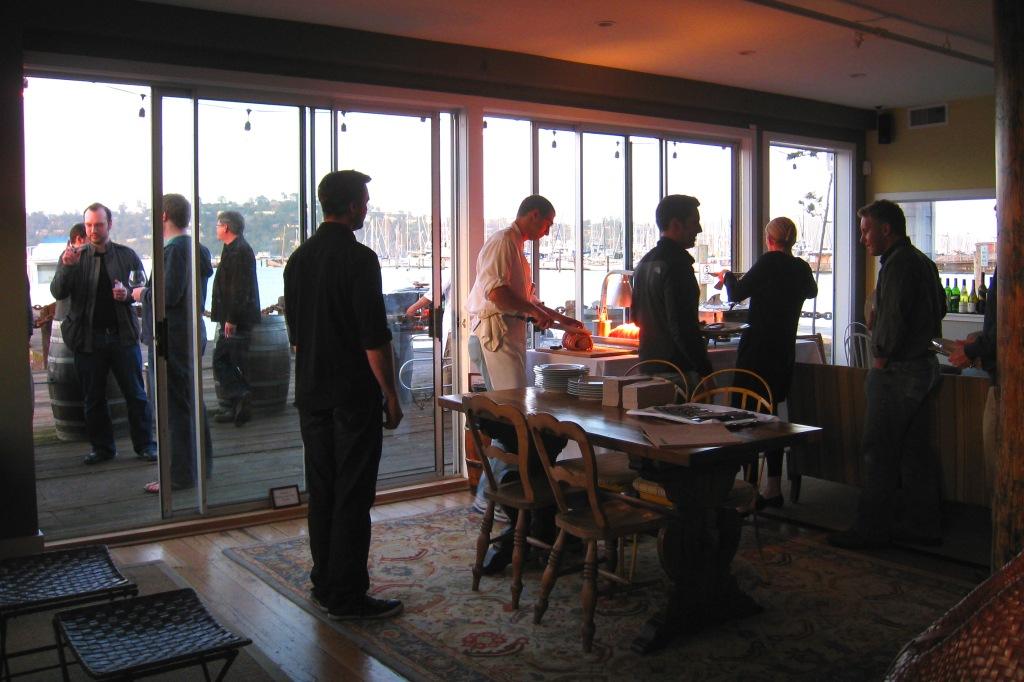
The meal turned out very well. The porchetta was moist and the skin of the pork belly crispy. I had never had minted peas before and frankly was not looking forward to them, but the mint was not overpowering and it was a good counterpoint to the pork. Alfredo had added some sour cream to the mashed potatoes and they were fantastic.

The spotted dick, prepared by Tara Ancona (CIBO’s pastry chef), also made its appearance and was served seated on some Crème Anglais.

Although I am not sure what recipe Tara used, per Wikipedia:

“Spotted dick is a steamed suet pudding containing dried fruit (usually currants) commonly served with custard, and a standard part of English cuisine. 'Spotted' refers to the dried fruit (which resemble spots) and 'dick' may be a contraction/ corruption of the last syllable of the word 'pudding' or a corruption of the word 'dog,' since 'spotted dog' is another name for the dish.”

For any who are interested, there are some commercial versions available, although one wonders about spotted dick in a can (thankfully we did not have to "go there" last night). On the other hand, obviously someone must buy it!

The only disappointment of the day was that we had been lead to believe that Jeremy would be present in full St. George Day regalia, complete with cape.

However, such was not the case. Perhaps next year? Something to look forward to for St. George’s Day 2011!

Continue Reading »

Be Tuscan Once a Day – A Friend Returns to Cavallo Point

Last year Alex, Cass and I had a great time at a cooking class at Cavallo Point taught by Judy Witts Francini who was visiting from Toscana. A few weeks ago when I saw on Judy’s “Over a Tuscan Stove” blog that she would be returning to Cavallo Point, I immediately signed up for the class. Alex and Cass were not able to join me this time, but my friend Kaz, who also loves to cook, agreed to come along to keep me company.

Kaz and I arrived at Cavallo Point a bit early, so we decided to kick the event off with an Anchor Steam Liberty Ale at Cavallo Point's Farley Bar, one of the nicest places in Northern California to pass some time while watching the Golden Gate.

Just before the class’ 4:30PM start time, Kaz and I headed upstairs, past the Gregory Colbert display of elephants, to the cooking school’s facility on the second floor. Judy greeted us at the door together with Jayne Reichert, the cooking school’s director, and Jayne’s colleagues, Rosalyn England and Jennifer Rudd. Happily, we discovered that a couple of friends, Reidun and Angela, were also taking the class.

One of the enjoyable parts of any cooking class is to see the ingredients laid out in preparation at the start. Cooking is like many things in life – sometimes the anticipation is almost as good as – or even better than - the ultimate consummation.

After everyone got settled in the room with glasses of Col Vetoraz Prosecco, Jayne introduced Judy who made a few comments (including how she had just escaped Europe on one of the last flights out before the Eyjafjallajokull volcanic ash cloud closed things down), and away we went.

Our menu for the day was:

~ Antipasto: Tuna with White Beans
~ Primo: Ragu with Pici
~ Secondo: Sicilian Grilled Braciole (stuffed beef rolls)
~ Cortorno: Garmugia (a Spring vegetable stew from Lucca)
~ Dolce: Chocolate Salame

Antipasto: Tonno con Fagioli

While she was making her introductory comments, Judy prepared and served the antipasto course - a Tuscan favorite of tuna with white beans and red onions. Very simple and a great combination. The beans, cooked with sage and garlic, were a dish we had prepared at our earlier class with Judy, and are excellent on their own. The tuna was from the Pacific and packed in olive oil.

After that appetizer, Judy divided us up into groups to tackle the remainder of the dishes.

Primo: Pici con Ragu

Kaz and I were assigned to il primo, with Kaz on pasta and me with the ragu team.

Pici is a Tuscan pasta - about the thickness of a pencil - which had its origins in the area around Siena. Nancy and I first tried it in 2006 when it was served at a wonderful dinner at a small restaurant named Osteria La Porta in the small town of Monticchiello
in central Toscana between Montepulciano and Montalcino. We were told by the proprietor that an older woman from the village came in each morning to make it. Most recently we had it at Sociale in Presidio Heights in San Francisco. One thing which distinguishes it from many other types of Italian fresh pasta is that it uses no eggs in the dough – simply flour and warm water.

Here is a collection of pictures illustrating the steps in the preparation (at least a couple of those hands belong to Kaz!). Notwithstanding the good work of the solitary matron of Monticchiello, it is the sort of dish where it certainly helps to have a team effort.


Jayne took the prize for the longest pici of the day – such a showoff. Accordingly to Judy the ability to make long pici is a highly-prized trait among young women (and hopefully today young men too) in the Siena area.

While Kaz was working on the pici, I was over with the group preparing the ragu. If we were in Toscana, the only proper meat sauce for pici would be one with cinghiale – the Italian wild boar which is found throughout Toscana.

However, for our dish, we used ground sirloin with a bit of prosciutto and porcini mushrooms. Not bad, but I always prefer a pork-based sauce. One tip Judy gave us when preparing the soffritto (the minced carrot, onion, celery mixture that forms the base of the ragu) was to let it almost burn in order to caramelize it fully and thereby enhance the flavor.

Secondo: Braciole Siciliane alla Griglia

The braciole were thin slices of beef rolled around a filling of breadcrumbs, garlic, chili flakes, parsley and lemon zest. Another Italian name for braciole is involtini, which is the name for this dish that I had heard before. Once the individuals pieces had been rolled up, we then took three rolls, put three skewers through them, and then cut between the skewers to form individual pieces - a nice trick.

Patrick and I learned to make a similar dish a couple of years back at one of our Sicilian cooking classes at Mezzo Mezzo in San Rafael (in that case named Involtini alla Palermitana) although that version used veal and a much richer filling (including ham, mortadella, cacciocavallo cheese, and pine nuts) and was sauteed in butter and white wine.

I also came across a wonderful post (with excellent photos) on the Lucy’s Kitchen Notebook blog about a class that Judy had taught at the Becchina Estate in western Sicily at which they had prepared an Involtini di Manzo (Stuffed Beef Rolls) dish that was similar to our Mezzo Mezzo dish, although it incorporated a tomato sauce. As Judy pointed out with virtually every dish, once you have the basic concept down there are many directions in which you can take it.

Contorno: Garmugia

Judy explained that this Spring vegetable dish – or at least its name - originated from the beautiful walled city of Lucca a bit west of Firenze in Toscana.

The group working on it was at the far end of the room so I did not see much of the preparation. However, the ingredients included sliced baby artichokes, fava beans, asparagus, peas, young garlic and pancetta.

Dolce: Salame Dolce

This was an interesting dish – one I had never heard of before but which is apparently well-known to every Italian child. Despite its name it is meat-less. Its ingredients included pieces of cookies to imitate chunks of fat (Petit Beurre cookies), sugar, butter, egg yolks, cocoa and grappa.

After forming a salame shaped log, the dish was wrapped in foil and put in the freezer to firm up.
Once all the prep work was done the cooking proceed pretty quickly.


The pici were boiled in salted water (per Judy, add the salt AFTER the water is boiling to avoid staining your pot) in batches, then added with ladles of the ragu to a separate pot until all were done.

Once everything was ready, the dishes were turned out, the salame dolce was sliced, we took our seats and were served.


In addition to the Prosecco we were served at the beginning of the class, during our meal we enjoyed a white 2008 Falanghina dei Feudi di San Gregorio and a red 2007 Langhe Nebbiolo from Parusso. Both excellent pairs.

Judy also had with her some copies of her new cookbook – “Secrets From My Tuscan Kitchen” – which includes recipes for the dishes we prepared, and which I was happy to see carries the "Tuscan Husband Seal of Approval" - è buono! = it is good! I picked up a copy.

It was another fun day at Cavallo Point thanks to Judy and the hard working Cavallo Point staff (from the left in the below photo: Judy with Jayne, Rosalyn, and Jen), and Kaz and I certainly had a good time.

Plus, where else can you walk out of class and be able to see night falling over one of the world’s most beautiful bridges?

I am looking forward to our next visit to Cavallo Point, not to mention Toscana!

Continue Reading »

Sunday, April 4, 2010

La Pasqua con Chi Vuoi – Easter Lunch at Angelino’s

Last Sunday I was at Angelino’s for lunch when Pasquale suggested I try a piece of “Pastiera” for dessert. When I asked what that was, he said it was a traditional Neapolitan tort prepared at Easter made in part from wheat berries, ricotta, candied citrus rind and “orange flower water.” I tried a slice and it was fantastic. When Pasquale told me they would be serving the dish on Easter Sunday along with roast goat (capretto) and a few other Easter specialties, I knew where I would be for lunch that day.

Easter Sunday started off overcast and cool this morning, and by the time Nancy and I got to Angelino’s at lunchtime it was raining hard with a cold wind. What happened to Spring?! Alex and Cass braved the Bay crossing on the ferry to join us and they were also waterlogged upon arrival. However, Angelino’s was bustling with a full house and a high energy level – a great spot to be on a chilly day.

Teresa seated us and Giancarlo brought us the special Easter menus. We ordered some Prosecco to start and perused our choices.

Alex and I both ordered the Antipasto Pasqualino and the Capretto, and Cass went with the Pansotti. Of the special Easter dishes, the first one that arrived at the table was the Neapolitan Easter Bread (called “Castiello”).

Castiello is an interesting bread which incorporates cheese and salumi – see this recipe from “The Italian Baker” by Carol Field, as well as this interesting challenge on the Pinch My Salt blog where a group of people have made Castiello based on the recipe in “The Bread Baker's Apprentice.”

The Antipasto Pasqualino was a very good starting dish – simple and light with a good mix of flavors, including the pecorino cheese, sopressata and fresh fava beans which are currently in season.

The Torta Pasqualina that came with the antipasto is a dish made with Swiss chard, ricotta and hard boiled eggs. Pasquale stopped by to chat with us and told us that the dish (see a recipe here) is originally from Liguria. Traditionally it was made with layers of filling alternated with paper-thin sheets of pastry -- 33 layers in representing each year of Christ’s life. Also, twelve eggs were added to represent the apostles. Pasquale’s preparation pared back on those ingredients a bit, but was still very tasty.

The Capretto was excellent - a large serving with a lot of garlic and some bones which made it convenient to to a bit of gnawing.

Cass’ Pansotti was another Ligurian dish - a stuffed pasta. It mean’s “pot-bellied” and Angelino’s plump version certainly fit that description.


The Pastiera at the end of the meal was as good as the one I had last week - enhanced this time by a scoop of gelato.

For our wine with our meal, Giancarlo recommended a bottle of the 2003 Castello di Salle Montepulciano d’Abruzzo from Sallis Castrum in Bolognano in Abruzzo, not far from Pescara and the Adriatic coast.

It was an easy drinking wine with light tannins and a perfect pairing for our lunch.


Continue Reading »

Friday, April 2, 2010

Mariposa Kitchen II – Indian Seafood

I was back at Carolyn Fey’s Mariposa Kitchen on Wednesday night for the second of the two classes with her that our son, Patrick, had given me for Christmas. I had a great time at the first class I took there in January - “Mediterranean Seafood.”

Since that first class I had been keeping an eye on Carolyn’s postings of new classes and a couple of weeks ago a new posting for an “Indian Seafood” class caught my eye. Since I do not know anything about Indian food (other than I like it), I thought it would be fun to give that a try so I signed up (although I have to admit the “Everything Tastes Better with Bacon” class was also quite tempting!).

It was raining heavily on the evening of the class and I was the first one at Carolyn’s apartment in the Marina where she gives her classes. Carolyn put me to work shelling peas for one of the dishes while she and her assistant bustled around getting everything ready. Before too long almost everyone was there, so after some Indian snacks and California wines (I really enjoyed the Angeline Pinot Noir), Carolyn handed out the recipes for the evening’s dishes and we retired to the kitchen to get started. Here was the evening’s lineup:

In Carolyn’s classes you are given the menu, shown where the ingredients and utensils are, and they you are off and running.


It seems a bit unstructured and chaotic at first (especially with all those knives in a small space), but both with our first class and this one everything ultimately came together very well and no lacerations were suffered. There were a couple of more people in this class that in the first one I took, but Carolyn’s kitchen still managed to accommodate us all with a minimum of bumping into each other.

Pete and I ended up working together on the Pacific Halibut Masala dish which, from the long list of ingredients (incidentally, Pete, what was that “asafoetida” ingredient and why is its nickname “devil’s dung”??) seemed like it would take for ever. However, it really did not end up taking long at all, and the actual cooking time for the dish was probably no more than 10-15 minutes. With all the different spices being used at the different stations, it was probably the most colorful and fragrant kitchen I have ever been in.

Once everything was ready we moved to the adjoining dining room and got going with the eating part of the evening. I can honestly say that every single dish turned out well, and there was a very good balance to the dishes.

The Mangalore Fried Shrimp (named after the city of Mangalore on the west coast of India) was the spiciest of the dishes, but it was certainly not overpowering and was tempered nicely by the yogurt-based Cucumber Raita. The Roasted Cauliflower, Peas and Potatoes with Garam Masala was also a bit spicy and a wonderful flavor combo. I had never had the Gajar Halva dessert, which is made with grated carrots, raisins, pistachio nuts, cloves and other spices, and was fantastic, especially with the cardamom ice cream. Carolyn said that Gajar Halva is served all over India with countless variations. It is hard to imagine a version better than hers.

Here are photos of the dishes we made in the order shown on the above menu, in each case with at least one photo of the preparation and of the final dish. I neglected get a shot of the Basmati Rice dish which I am disappointed about since it had a very interesting moist texture resulting from the coconut milk used for it.


The only disappointment of the class for me was that we did not have time to talk more about the styles of Indian cuisine and the ingredients we used. However, Carolyn did direct us to the New India Bazzar at Polk Street in San Francisco and I look forward to dropping by there one day. She also recommended Dosa (the Valencia location over Fillmore) as a good place for Indian food in San Francisco.

Now about that bacon class....

Continue Reading »