Showing posts with label Goat. Show all posts

Friday, April 22, 2011

Roast Goat Shoulder with Black Olives and Herbs

One Sunday morning a couple of months ago while at the San Rafael farmers market I picked up a goat shoulder roast at the Rossotti Ranch stand. I had never cooked a goat shoulder before, but my prior efforts with Rossotti Ranch's goat had turned out so well that it seemed worth a try.

I had put the shoulder in the freezer and had forgotten about it until earlier this week when I happened across a recipe I had found on the Rossotti Ranch website (that and other good recipes are available
here). I made the dish this evening and it turned out very well. The shoulder - which is not a very big cut (mine was about 2 pounds) - includes a good deal of connective tissue and is chewy, but I like that consistency in meat and the flavor was excellent. Here's the variation of the recipe I used:


INGREDIENTS

• 1 goat shoulder roast, 2-3 lbs
• Salt & ground pepper
• 1 large carrot, peeled and diced
• 1 celery stalk, diced
• 1 small yellow onion, chopped
• 4 cloves garlic, sliced
• 5-6 fresh flat-leaf parsley sprigs, plus 2 tablespoons chopped
• 2 or 3 fresh oregano sprigs
• Extra virgin olive oil for coating
• 2 cups beef broth
• ½ cup dry red wine
• 10-12 kalamata olives, pitted and coarsely chopped
• 2 tablespoons capers, rinsed and chopped
• 1 tablespoon tomato paste
• 1 teaspoon red wine vinegar
• 1 tablespoon cornstarch

PREPARATION

1. Trim away all but a thin layer of fat from the goat. Rub the meat all over with the salt and pepper, place on a plate, and refrigerate for 12-24 hours. Remove from the refrigerator about 1 hour before roasting.

2. Preheat the oven to 400°F

3. Select a heavy ovenproof pan just large enough to hold the goat. Add the carrot, celery, onion, garlic, parsley sprigs, and oregano to the pan. Lightly brush or rub the goat with olive oil and place, fat side up, on the vegetables. Pour in the broth and wine.

4. Roast the goat for 1 hour. Remove from the oven and turn the roast. Reduce the oven temperature to 325°F. Continue to roast the goat for 20 minutes, then remove the pan from the oven and turn the roast again fat side up. Continue to roast until a thermometer inserted into the thickest part registers 180°F, 20 minutes longer.

5. Remove the pan from the oven, transfer the goat to a warmed platter, and tent with aluminum foil. Let rest while preparing the sauce.

6. Pour the contents of the pan through a coarse sieve placed over a bowl. Using the back of a spoon, press on the contents of the sieve to extract as much liquid as possible. Discard the contents of the sieve. Using a spoon, remove as much fat from the surface of the pan juices as possible. You should have about 1½ cups of liquid. Pour into a saucepan and place over medium-high heat. Bring to a boil and add the olives, capers, tomato paste, vinegar, and chopped parsley. Reduce heat to low. In a small bowl, dissolve the cornstarch in 2 tablespoons water and whisk into the simmering sauce. Cook, stirring, until slightly thickened, 2-3 minutes. Season to taste with salt and pepper. Keep the sauce warm.

7. Transfer the goat to a carving board. Cut the meat into slices ¾ – 1 inch thick and arrange on warmed plates. Spoon a little of the sauce over the meat. Pass the remaining sauce at the table.
Continue Reading »

Sunday, September 5, 2010

Shanks Very Much

After our very enjoyable recent cooking class at Cavallo Point featuring Rossotti Ranch goat, I could hardly wait to try some additional goat dishes. Happily the Rossotti Ranch website features a number of recipes to explore.

One recipe in particular -- for Barbecued Goat Shanks -- caught my eye (see the recipe furthest below). As described there:

“Goat shanks are not for the dainty. Goat shanks are served whole, a leg on a plate – think cave cuisine! These shanks are permeated with North African spices; they radiate cinnamon, thyme, coriander and lemon – an exotic harmony.”
So last Sunday I stopped by the Rossotti Ranch stand at the San Rafael farmers marked and picked up a couple of shanks from Julie Rossotti.

After a bit of delay, they finally hit the grill this evening.

The preparation was very easy -- here is a shot of the ingredients:

I was particularly interested to see how the North African spice rub would work out since I had never tried anything like that before.

I used our Weber for the grilling - indirect heat as indicated in the recipe. A pleasant task sitting out on our deck with an Anchor Steam keeping an eye on the grill temperature and listening to the sounds of the bands playing down the hill at the Sausalito Art Fair.

The shanks turned out very well and I thought the North African seasoning was great. It was very well balanced and not at all overpowering.

Here are a series of shots showing the progression of the shanks through the evening -- Raw ►Rubbed ►Grilled ►Gnawed.


As indicated by the Rossotti Ranch comment above about “cave cuisine,” you would not want to consume this dish in polite company. For full enjoyment you definitely need to be in an environment where you can get both hands on the shank and have your way with it.

Apart from the seasoning, the goat meat itself was excellent - very mild flavor and extremely lean. There was also a surprising amount of meat on the shanks (and these were the smaller of the shanks they had available last Sunday). I am looking forward to having this dish again.

=====================

Here is the Rossotti Ranch recipe which I followed exactly, except for substituting fresh lemon zest for the dried lemon peel, and sea salt for kosher salt.

Ingredients:

4 goat shanks
½ cup extra virgin olive oil
¼ cup fresh lemon juice
¼ cup fresh parsley, chopped
3 cloves garlic
1 tablespoon tomato paste

For the Rub:

2 teaspoons cinnamon
2 tablespoons dried thyme
1 teaspoon dried lemon peel
2 teaspoons ground coriander
1 teaspoon ground turmeric
2 tablespoons sugar
2 teaspoons kosher salt
1 teaspoon black pepper

Preparation:

1. Heat the grill: Indirect heat, medium (325°-350°)

2. Rub the goat shanks with 1 tablespoon of the olive oil and the rub mixture.

3. Mix the remaining olive oil, lemon juice, parsley, garlic, and tomato paste in a bowl; set aside.

4. Place the goat shanks on the grill away from the heat, cover the grill and cook until an instant read thermometer inserted into the thickest part of a shank registers about 155°F, about 1 hour. Turn and baste with parsley sauce 3 or 4 times while cooking.


Continue Reading »

Friday, August 27, 2010

The Goats of Rossotti Ranch

I really like goat, so a few weeks ago when I noted at the Sunday farmers market in San Rafael a new stand -- Rossotti Ranch -- featuring goat meat, I stopped by to say hello. Rossotti Ranch is just west of Petaluma and is owned and operated by Tony and Julie Rossotti who come from different two families which both have roots in agriculture and livestock raising in Marin - between them a total of nine generations.

I have had goat in a number of different forms over the years -- primarily in Mexican places (e.g. as birria or barbacoa), but also a memorable goat and lamb meatball dish (Polpettine di Capra e Agnello in Verde) we enjoyed at a dinner at La Ciccia featuring the cuisine of Abruzzo.

I had also begun to notice more articles in the food press about goat with some intriguing recipes, including:

~ NY Times: “How I Learned to Love Goat Meat
~ SF Chron: “Goat Breaks into Bay Area Menus

However, I had never tried to prepare goat myself, so I was interested to see what Rossotti Ranch had to offer.

Rossotti Ranch has a very good website with some tasty-looking recipes (in particular, their North African Barbecued Goat Shanks caught my eye). The site also includes some interesting information about the healthy qualities of goat compared to other meats:

One of the first things I learned while talking with Tony and Julie was that they would be participating in an upcoming cooking class sponsored by Marin Organic at Cavallo Point - an event featuring both goat from Rossotti Ranch, and vegetables from Dennis and Sandy Dierks’ Paradise Valley farm in Bolinas. Having had such good experiences on previous events at Cavallo Point, I went right home and signed up.

The class was last Tuesday night. Our good friends, Sandy and Connie Calhoun, who are good sports when it comes to exploring different cuisines, joined me.

Jayne Reichert, the Director of the Cooking School, opened the doors to the classroom for us at 6:00, and after a glass of prosecco and a chance to look over the ingredients and meet the Rossotti’s and the Dierks, we took our seats and the program got started.

The following was our menu for the evening:

~ Roasted Beet Salad with Creamy Garlic Chive Dressing
~ Goat Meatballs with Potato Gnocchi, Green Beans and Parsley Pesto
~ Goat Shoulder braised with Allspice and Oranges and served with Oven Roasted Kohlrabi, Sautéed Lacinato Kale and Over Roasted Tomatoes with Basil
~ Nectarine Tart with Cornmeal Crust

and here are a set of photos of the final dishes:

We prepared everything during the class, with the exception of the braised goat shoulder which Jayne had started earlier in the day given the time required to cook it.

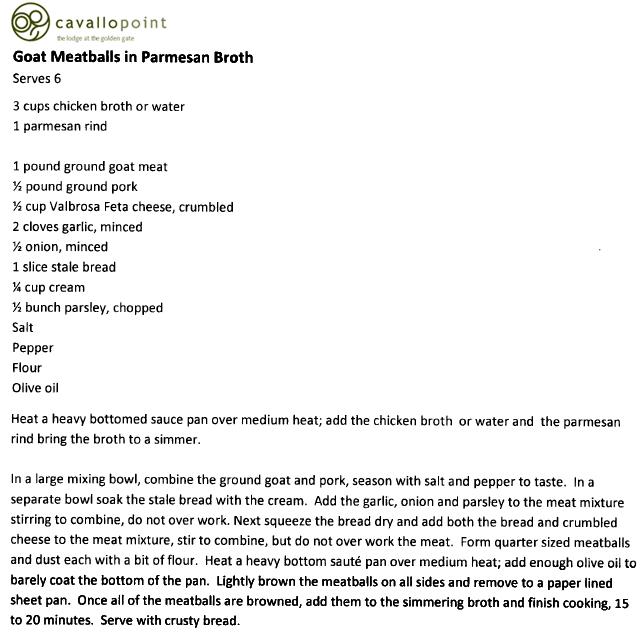
Everything was great, although the dish that I thought was best and that I plan to try in the near future was the meatballs. Here is the recipe for that dish:

A similar recipe appeared in the New York Times article cited above.

Given that goat is so lean, both recipes recommend the addition of pork to provide a bit more fat content. The meatballs were formed using as delicate a touch as possible, then lightly browned in a skillet, and finally placed in a chicken stock in which a large Parmigiano-Reggiano rind had been simmering. The meatballs were then further simmered in the stock and served with it.

The meatballs were served with potato gnocchi (incidentally, for aspiring gnocchi makers, here is an excellent how-to video featuring Paola Bagnatori of the Museo ItaloAmericano) and green beans which was a very nice counterpoint. However, if I was to make the dish, I think I would substitute some Cannellini beans for the gnocchi (perhaps the excellent Tuscan White Beans with Sage and Garlic (Fagioli alla Salvia ed Aglio) dish we made at Cavallo Point with Judy Witts Francini) or just serve the meatballs with pasta - perhaps with a light tomato sauce or pesto Genovese.

Continue Reading »